

 transCampus Team,
What does it take to advance cutting-edge research in applied stochastics? For the PhD student Shend Thaqi from TU Dresden, it meant spending nine months at King’s College London in the vibrant Probability Group. As part of the transCampus programme the research stay was designed to deepen the work in an international environment and foster collaboration with leading experts.
The student’s research focuses on stochastic analysis in infinite-dimensional spaces, tackling questions about the regularity of specific classes of stochastic processes—a field at the crossroads of algebra, analysis, and probability theory. During the stay, he worked on a joint project between TU Dresden and King’s College, together with his supervisors Anita Behme (TUD) and Markus Riedle (King’s). This collaboration led to a joint publication, with another paper currently in the works.
The academic highlight of the stay was presenting this work at the weekly Probability Group seminar, wich usually includes talks by internationally renowned mathematicians. Additionally, Shend and the group participated in the London Probability Day, an event that brought together experts from probability theory and related fields. What set the experience apart was the vibrant research environment at King’s College. With around 70 PhD students and postdocs sharing collaborative office spaces, discussions often extended beyond formal seminars to spontaneous exchanges at office whiteboards or in hallway conversations. The proximity to other leading universities like Imperial College and Cambridge further enriched the academic experience through workshops and conferences.
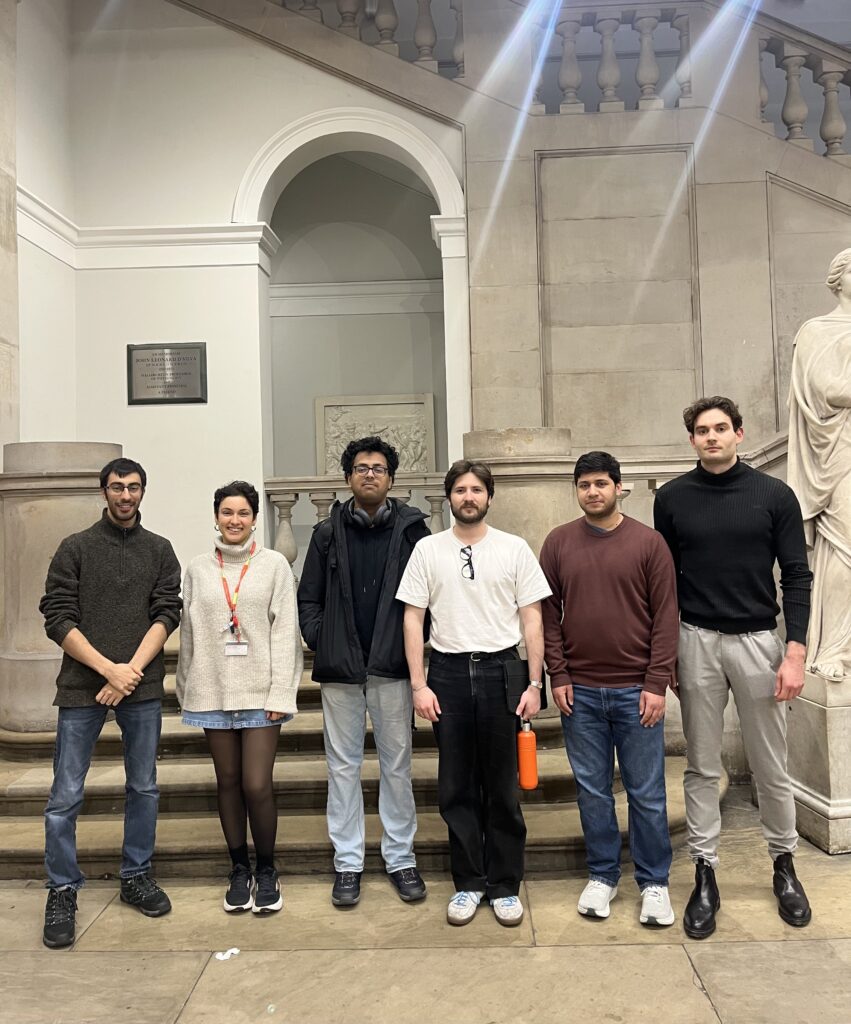
Beyond the research, the stay fostered valuable connections with other young researchers from diverse mathematical schools and cultural backgrounds. “This exchange has not only advanced my research but also broadened my academic and personal horizons,” Shend reflected. The stay at King’s College London exemplifies how international collaboration can create fertile ground for innovation and growth in research. For aspiring young researchers, it’s a reminder of the value of stepping outside one’s academic comfort zone to engage with the global scientific community.